The Sculptor Heuristic
A production strategy that maximizes Iteration.
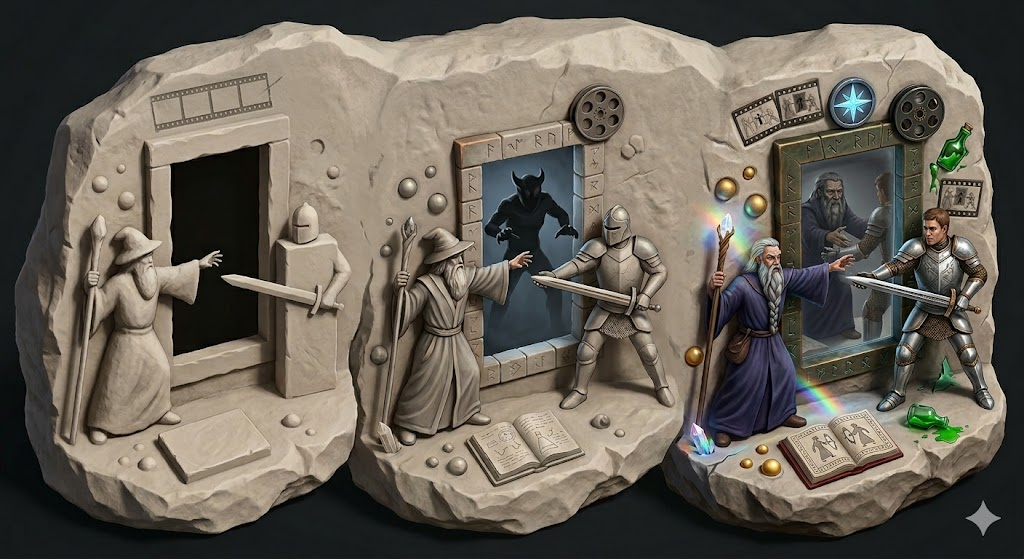
Most productions run on a linear logic. A plan is built. Departments execute it in sequence. Each component is treated as a one-shot opportunity — you invest fully in it, complete it, hand it off, and move on. The creative process is expected to end early, so that execution can begin cleanly. By the time the full picture exists, the space for changing it has closed.
This is not a failure of competence. It is the natural result of treating a production as a pipeline rather than a material.
Consider a game in production. A level designer blocks out an area. An artist takes that blockout and builds detailed geometry. A lighter takes that geometry and begins placing lights. A gameplay scripter wires interaction points to that geometry. By the time a director sits down and says "this space doesn't feel right" — they're not looking at clay anymore. They're looking at four departments' worth of committed work. The cost of changing the space is not the cost of changing the space. It's the cost of unwinding everything that was built on top of it.
The same logic plays out in software. A developer analyzes requirements, writes a spec, designs an architecture, and then implements bottom-up — building the complex subsystem that everything else will depend on. When the requirements shift, or when the system meets real usage and turns out to be solving the wrong problem, the cost is structural. The architecture was a bet placed early, in full.
Both approaches share a hidden assumption: that depth of investment in a component is the right unit of progress.
The Sculptor Heuristic rejects this.
The unit of progress is not the completeness of any individual component. It is the completeness of the whole.
The goal of every stage is the first complete whole — feature-complete within the defined scope, not more and not less. Every component exists at that stage. Every component is at the level of effort that makes the whole reviewable, not the level of effort that makes the component finished. Think of it as the economy of a prototype, but with the intention of iterating it into a polished product.
The prototype and the Sculptor Heuristic share the same work rate per component: low commitment, path of least resistance, good enough to exist and function. The difference is intent. A prototype is built to be discarded. The Sculptor Heuristic builds with the understanding that everything is replaceable, extensible, and mutable — but nothing gets thrown away. Each pass improves the whole.
What this produces is an iteration window. The span of time between when a team can meaningfully review and change the work, and when they have to stop changing it to ship.
Standard production approaches compress this window from both ends. Heavy upfront planning delays the first reviewable whole — you can't meaningfully review a plan, only a thing. One-shot component execution means late-stage changes arrive with structural debt attached. The window that remains is narrow, and it opens late.
The Sculptor Heuristic maximizes this window. The first reviewable whole arrives early, because each component only cost what was needed to make the whole work. Changes at any stage are cheap, because no component has been invested beyond its current role. The window stays open until you choose to close it.
This is what makes it a production strategy, not just a development philosophy. The creative director who wants to change the feeling of a level three weeks before ship — they are not asking for something unreasonable. They are asking for something that the production methodology either affords or forecloses. The Sculptor Heuristic affords it.
There is a prerequisite. This strategy is only available in an environment where components are modular, scriptable, and swappable — where the medium itself supports mutability. A game engine affords it. A DAW affords it. A film shoot with practical sets and locked shooting days does not, or at least not without significant preparation cost. The methodology follows from the material.
And within that environment, there is a skill requirement. Not every developer or technical director naturally works this way. The standard training runs in the opposite direction: analyze requirements, design architecture, implement systems. Abstraction is taught as an architecture tool — a way of structuring a system for runtime flexibility or future extensibility.
In the Sculptor Heuristic, abstraction is a judgment instrument. It reads the shape of what you have. It asks: what needs to change together? What needs to stay independent? What can be committed to now, and what needs to remain open? The answers inform what gets coupled and decoupled — not according to a design pattern, but according to what the work is actually doing.
When a complex subsystem is needed to make one step work, you add the most naive version first. Not because you're cutting corners, but because the naive version is sufficient for the whole to be reviewable — and the whole being reviewable is the only thing that earns the right to go deeper.
The creative process does not need to end at the beginning. It needs the whole to exist early enough that there is something real to be creative against.
The Sculptor Heuristic is how you get there.
-- Written with Claude using the Obsidian MCP to link original ideas from my Zettelkasten.